
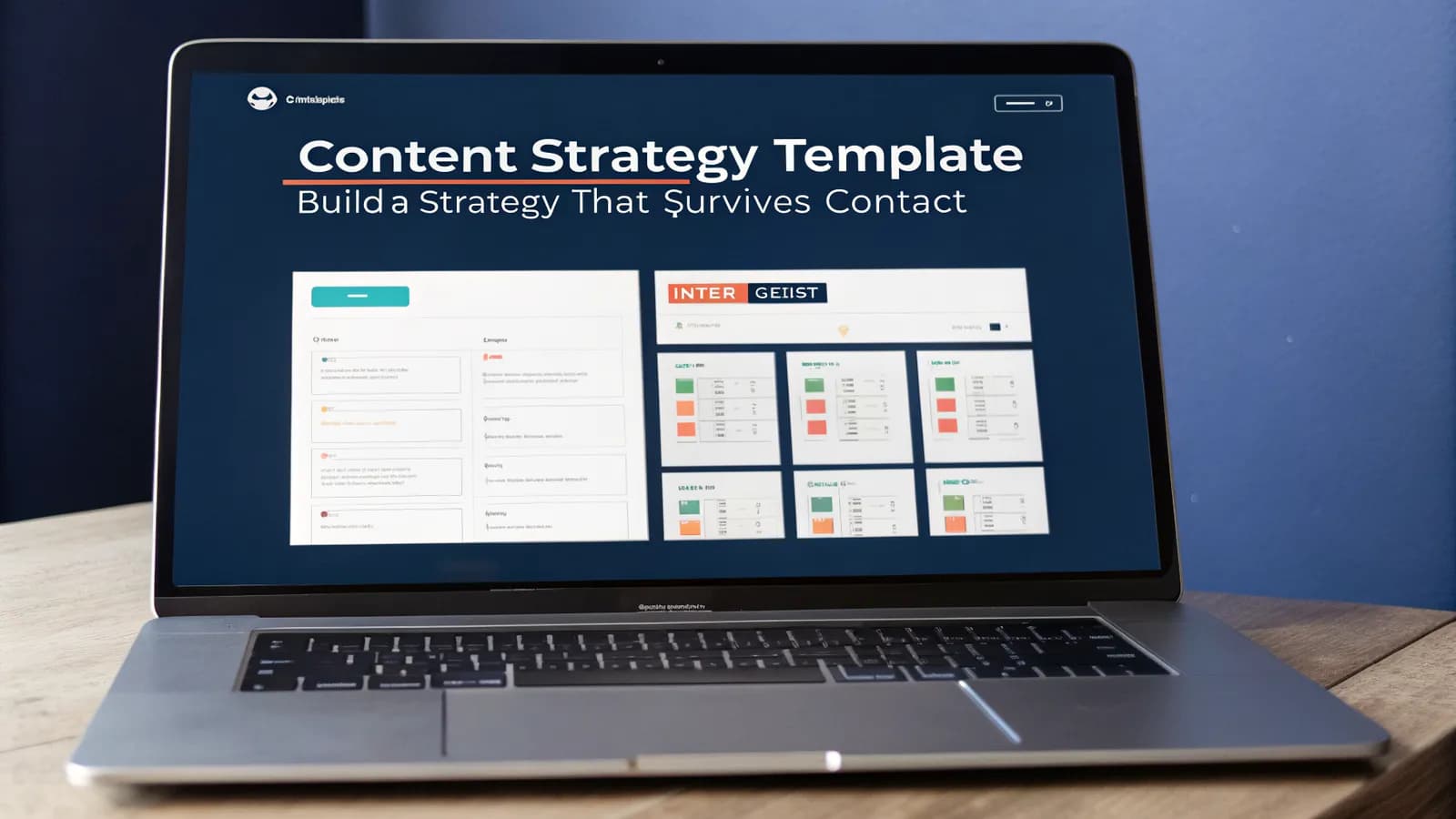
The budget meeting is coming, and the content plan you wrote in January won't survive it. Not because it was wrong, but because it was a list of what you'd publish, and no one in the room could see what it would stop or prove. A content strategy template is supposed to answer that. Most templates stop at five sections from 2019: goals, audience, calendar, channels, KPIs. They have no column for AI search, no stop-doing list, no review date. Meanwhile 94% of marketers are using AI in content creation, and only 19% track AI-specific KPIs. So is the template you're working from built for the search landscape your content actually lives in now?
If you run content for a living, you've probably sat through the budget meeting where your work gets quietly redefined: fewer posts, same output, "can we pause the blog until Q2?" The plan you wrote in January doesn't survive that conversation. Not because it was wrong. Because it was a list of what you'd publish, and nobody in the room could see what it would stop, what it would prove, or who it was for. A content strategy template that can't answer those three questions isn't a strategy; it's a wish list with formatting. The one below is built to force the answer, section by section, before the budget season finds you.
The 10-Section Content Strategy Template
A content strategy template is a one-page document that turns your publishing output into a plan: who you write for, what you commit to, where it goes, and how you know it works. Fill it once, and every content decision after it (the blog post idea, the channel, the refresh, the kill) has somewhere to be checked against.

Most templates stop at five sections: goals, audience, calendar, channels, KPIs. That's a marketing plan from 2019 with better formatting. The version below adds what a 2026 strategy actually has to hold: an AI-search layer, a stop-doing list, and governance (who owns the strategy and when it gets reviewed). Steal the whole thing; it's built to be copied.
1. Audience segments
Name the 2–3 people your content exists for. Skip the personas with stock photos; describe segments you can actually recognize. For most B2B teams that means: the buyer (e.g. "head of marketing at a 10–50 person SaaS"), the hands-on operator (the SEO specialist who will find you via a query), and often an internal stakeholder (sales, who forwards your comparison pages). Give each one a line: role, company size, what they're measured on. If you can't name them, every content decision defaults to "everyone," which means no one.
2. Pain points and questions per segment
For each segment, list the problems they bring to search and the questions they ask out loud in meetings. This is where your content ideas should come from: your customer research, not competitor topic lists. A pain point has a cost attached ("our trial activation is below target"), a question has an answer format ("what's the cheapest way to test this tool?"). Write both down. You'll map content to them in section 3.
3. Content pillars
Pillars are the 3–5 topics you're willing to be known for. The test for a pillar: if someone read everything you publish under it, would they trust you on that subject? Choose pillars where you have defensible expertise or data, not just search volume. A pillar should have a measurable share of your roadmap: if you have five pillars and one of them gets 5% of your output, it's not a pillar, it's a hobby.
4. Channel mix
Where the content lives and why. The honest version of this section rarely lists more than three primary channels: your owned blog (for search and AI citations), one social channel that actually returns engagement, and email. Add channels only when you can state what they're for. "We're on LinkedIn because everyone is" is not a strategy; it's a line item your budget review will cut.
5. Cadence and production capacity
What you can actually produce, sustained, for a quarter, not what you'd produce with two more hires. Content Marketing Institute's 2026 B2B research found that only 29% of organizations with documented strategies rate them highly effective, and 58% call them only moderately effective. The biggest driver of improvement wasn't more budget; it was refining the plan. A realistic cadence column (pieces per week, per format, per owner) is the single most honest number in this document, because every other section has to fit inside it.
6. SEO and AI-search targets
This is the section 2023 templates don't have, and it's why the strategy needs an update. In 2026, 94% of marketers plan to use AI in content creation (HubSpot State of Marketing 2026), yet Digital Applied's 2026 data shows only 19% track AI-specific KPIs. AI search referrals are still a small slice of traffic, but clicks from AI Overviews convert about 23% better than average. The adoption-to-measurement gap is where your strategy can win. Write down, per pillar: which classic keywords you're defending, which AI surfaces you want to be cited in (ChatGPT, Perplexity, Google AI Overviews), and what an "AI citation" would look like for your brand. Teams that close the adoption-measurement gap see roughly 2.4× better content ROI. That number starts here, in this section.
7. Formats
The shapes your content takes, matched to the pain points from section 2. A definitional question wants an answer-shaped post with a cited source. A comparison question wants a table. A budget-season question wants a one-pager your sales team can send. List 3–4 formats you commit to and what each one is for. If every idea is "blog post," the format column is telling you your pillar list is actually a keyword list.
8. Measurement
Choose the metrics that prove the strategy, not the ones that are easiest to screenshot. Per pillar, define: the ranking terms you track, the traffic floor that justifies the effort, the engagement or conversion event that makes a piece "working," and the AI-visibility signal (brand mentions in AI answers, citations). Write the review date next to each metric. CMI's research ties the effectiveness gap directly to strategies without clear ROI goals; this section is where you close it.
9. Governance and the stop-doing list
Who can change the strategy, and what you're deliberately not doing. The stop-doing list is the section every content team skips and every budget review rewards: name the content you're killing or refusing, like the weekly blog post on topics outside your pillars, the reposting to four social channels nobody reads, and the "thought leadership" pieces no one can connect to a business outcome. Salesforce's 2026 State of Marketing found 87% of marketers use generative AI in at least one recurring workflow, up from 51% in early 2024. When adoption moves that fast, "what we don't do" is the only stable reference point your team has.
10. Quarterly review
A date, an owner, and a short protocol. Every quarter: check each pillar's measurement section, kill or fold whatever underperformed, refresh the AI-search targets (they move fastest), and rewrite the stop-doing list. Strategy is a living document, not an annual artifact. Siege Media's 2026 research shows 52% of content marketers are shifting budgets toward video and multimedia to stay competitive in AI-driven search, and 31% of teams now budget $15,000–45,000 per month on content, up from 19.3% a year earlier. Budgets of that size get reviewed. A strategy with a scheduled review beats one that waits for the budget meeting to discover it.
Audience, Pillars, and the AI-Search Layer
The template downloads you've tried before share a quiet problem: age. Semrush's editorial template page, one of the top results for "content strategy template," was last meaningfully updated in August 2024. The Content Marketing Institute's flagship template post dates to December 2018. Both predate AI Overviews, ChatGPT citations as a marketing channel, and the ranking windows those systems created. A template built before AI search can't plan for it, because it doesn't have a column for it.
That's why the structure above treats AI-search targets as a first-class section rather than an afterthought. Concretely, the AI layer changes three decisions in your strategy:

- What you write. AI answers cite sources that are structured, quotable, and attributed. An answer-shaped paragraph naming a source is a different assignment than a generic blog post, with different research, a different format, and a different success metric.
- Where you defend. A ranking term and an AI citation are different assets. Your pillar pages should do both: rank for the query and be the answer the AI surface pulls.
- How you measure. If 67% of content marketers use AI tools daily but only 19% track AI-specific KPIs, most teams are flying blind on the channel that's growing fastest. The 2.4× ROI difference between teams that close the gap and teams that don't is the business case for this section.
One more thing to track here: your audience's own behavior. Digital Applied's data shows AI search referrals are still around 3% of traffic for most sites, but those clicks convert better. Content Marketing Institute research (via Digital Applied, April 2026) found 73% of B2B marketers now report having a documented content strategy, and a documented strategy correlates with roughly 3× more leads than none. If your buyers are already asking AI tools for recommendations, being absent from the answers isn't a future problem. It's a current gap in your funnel.
How to Fill the Template in a Day
A full strategy template shouldn't take a week. It should take one working day, with the honest parts left for you and the mechanical parts done fast. Work in this order:
- Audience segments and pain points (2 hours). Pull your last 20 sales calls, support tickets, or search queries. The words customers use are your segments and pain points; don't invent them from a persona template.
- Stop-doing list (30 minutes). Write down everything you currently publish that you'd kill if you could. This is faster than it feels and more revealing than you expect. Most teams find 20–30% of their output exists because "we've always done it."
- Pillars from pain points (1 hour). Group the pain points into 3–5 clusters and name each cluster. Those are your pillars, drawn from customer language rather than competitor keyword lists.
- Cadence and formats (1 hour). Be honest about capacity. If you can sustain two quality pieces a week, the template says two. Overcommitting is how the previous strategy died.
- AI-search targets (1 hour). For each pillar, list the classic keywords you defend plus the AI surfaces you want to appear in. If you're not sure what your brand currently gets cited for, run a few of your own questions through ChatGPT and Perplexity and note whether you show up. That research is the raw material for this section.
- Measurement and review (1 hour). Pick the metrics, the dates, the owner. Skip the vanity numbers; you'll review this quarterly and you want to see change, not reassurance.
- Channel mix last (30 minutes). Decide channels only after everything above is written. Channels follow the audience and capacity, not the other way around.
What to skip when you're short on time: the competitive audit (do a light version later), the content audit of every old post (sample the top 20 by traffic), and any section that requires data you don't have yet. Leave it blank, mark it "to verify," and set a reminder. A template with three honest gaps beats one with seven confident guesses, and false certainty is exactly what the review process exists to catch.
Content Strategy vs. Content Plan vs. Content Calendar
The document stack confuses everyone, including vendors who sell templates, so here's the line that keeps it straight:
- Content strategy: why you publish and for whom: audience, pillars, stop-doing list, measurement. This document.
- Content plan: the topics you'll cover this quarter, matched to pillars and goals. Your content brief template fills in the per-piece detail: target keyword, angle, outline, internal links.
- Content calendar: what goes out and when: dates, statuses, owners, refresh due-dates. See our content calendar template for the 2026 version that tracks refresh cycles and AI-search surfaces, not just publish dates.
Strategy answers "why," plan answers "what's next," calendar answers "when." Most teams operate with only the last two and wonder why the work feels scattered. If you're building this stack for the first time, the order matters: strategy first, then plan, then calendar, never the reverse. Once pieces exist across all three layers, the operational glue between them is content orchestration, the coordination layer that keeps the strategy from being a document nobody feeds.
If your strategy runs deep enough to need an SEO roadmap underneath it, our SaaS SEO strategy guide covers the content pyramid, comparison pages, and PLG intent capture that a B2B content strategy usually leans on.
How AI Writes — and Maintains — Your Content Strategy
The template above answers a specific failure: strategies that are written once, filed, and forgotten. A better template file won't fix that. What fixes it is turning the strategy into something that gets fed with data and reviewed on a schedule, which is exactly the kind of job AI should do, as long as you stay in control of the decisions.
At Allable, we built this workflow for our own agency clients, and it's why the Strategy module exists. You give the platform your market and content context once (your segments, voice, goals, and banned topics), and it keeps that context across conversations. From there, the flow is: market analysis pulls real search and competitive data into the audience and pillar sections, a strategy draft comes back in this template's structure, briefs are generated for the first pillar articles, and the strategy is revisited as performance data arrives. Decay signals flag pillars that need refresh, and new search terms feed back into the pain-point section. It doesn't replace your judgment on what to stop doing. It makes sure the strategy actually gets maintained, which is the part every static template fails at.
Whether you use Allable or not, the principle stands: a strategy that isn't reviewed against data is a strategy that will be surprised by the budget meeting. If you want the AI-assisted version of this loop (market analysis into strategy into briefs into published content, with the strategy kept honest by performance data), the free plan includes 300 credits a month, and Pro runs €37/month (or €31/month billed annually). Fill the template once, and let the platform keep it honest.
Frequently Asked Questions
- What is a content strategy template?
- A content strategy template is a reusable document that structures the decisions behind your content: who you publish for, which topics you commit to, where content goes, how often you can produce it, and how you measure success. It's the "why and for whom" layer that sits above a content plan and calendar.
- What are the main sections of a content strategy?
- The core sections are audience segments, pain points, content pillars, channel mix, cadence, and measurement. A 2026 strategy adds three more: an AI-search layer (which AI surfaces you target for citations), a stop-doing list, and governance with a quarterly review protocol.
- How do I create a content strategy from scratch?
- Start with your audience's real words — from sales calls, support tickets, and search queries — and group their pain points into 3–5 pillars. Then set an honest cadence, choose formats per pillar, define measurement and a review date, and write the stop-doing list. Fill it in one day, in that order; skip sections that need data you don't have and mark them for verification.
- What's the difference between a content strategy and a content plan?
- A content strategy defines why you publish and for whom: audience, pillars, channels, measurement, and what you refuse to do. A content plan selects the specific topics for the quarter and matches them to pillars and goals. The calendar then schedules those topics. Strategy → plan → calendar is the order they work in.
- How often should I review my content strategy?
- Quarterly, on a fixed date with a named owner. Each review checks pillar performance against the measurement section, kills or folds underperformers, updates AI-search targets (they move fastest), and rewrites the stop-doing list. A strategy that waits a year between reviews is a document, not a strategy.
Bottom Line
The content teams that survive budget season aren't the ones with the most output. They're the ones who can say what they publish, why it matters, and what they've deliberately stopped doing. This template gives you that — ten sections, fillable in a day, with the AI-search layer and governance that 2026 actually requires.
So before you copy another template, ask yourself whether the one you're using right now would survive a conversation with your CFO. If it wouldn't, you know which section to start with. A strategy that survives contact is built for review: updated with data, defended in meetings, and honest about what it refuses to do. Build it once, review it quarterly, and let the market keep it honest. What are you going to stop doing this quarter?